When Did We Begin Believing Imagination Was Something We Were Supposed to Outgrow?
Life at the Hearth
by Sonia Vale
Children rarely need permission to imagine.
Give a child a cardboard box and it may become a house, a ship, a stage, or something for which adults haven’t yet invented a name. A stick can become a wand. A blanket draped across two chairs can contain an entire world. And for a while, no one has to explain why any of it makes sense.
I understood that kind of imagining very well as a little girl.
I was the youngest of nine children, and by the time I was old enough to remember much of my childhood, my older siblings had either left home or were old enough that playing with their youngest sister wasn’t particularly interesting. I was shy and introverted, and I spent a great deal of time alone.
So I made company.
I invented people and stories and then played every role myself. I could carry on entire conversations out loud for hours. We didn’t have much money, so ordinary objects became whatever the story required them to be. I didn’t think of this as creativity or storytelling. I certainly didn’t think of it as something useful.
I was simply imagining.
And I was very good at it.
Perhaps too good, according to some of the adults around me.
I daydreamed enough that teachers requested meetings with my family. Adults sometimes worried that I spent too much time inside my imagination. And as my interest in drawing became more obvious, imagination began bumping into another word adults seemed to take much more seriously:
Practicality.
As I grew older, drawing became another place where imagination lived for me.
I noticed things differently. Even when I was very young, I understood that people weren’t really made of the stick figures children often drew. Bodies had shape and weight. Faces had dimension. I wanted to understand how those things fit together and how to put what I saw—or imagined—onto paper.
Eventually, other people began noticing my ability too.
But encouragement and recognition weren’t always enough to quiet the message I was beginning to absorb: creativity was wonderful as an interest, perhaps, but adulthood required something more practical.
Somewhere along the way, imagination had acquired conditions.
It was acceptable as long as it remained a hobby. Sensible as long as it didn’t interfere with more serious ambitions. Charming in a child, perhaps—but increasingly questionable as that child grew older.
And I don’t think my experience was unusual.
Many of us learn some version of this lesson.
We stop asking What if? quite so freely. We become more concerned with what is realistic, responsible, achievable, or useful. Those aren’t bad questions. Adulthood requires many of them.
But sometimes, without realizing it, we allow those questions to become walls.
For a while, I did too.
I stopped drawing.
Not forever.
Just long enough to discover something when I eventually picked up the pencil again:
My imagination had been quiet.
It had not disappeared.
When I picked up the pencil again, I expected that perhaps I would have to find my way back.
Instead, something familiar was waiting for me.
The ideas came. The images came. That instinct to look beyond what was immediately in front of me—to wonder, rearrange, invent, and imagine—was still there.
It was as if my imagination had never taken a break.
I have thought about that many times over the years.
Because perhaps imagination doesn’t disappear simply because we stop using it.
Perhaps it waits.
We tend to associate imagination with childhood, art, storytelling, and play. But imagination is much larger than any of those things.
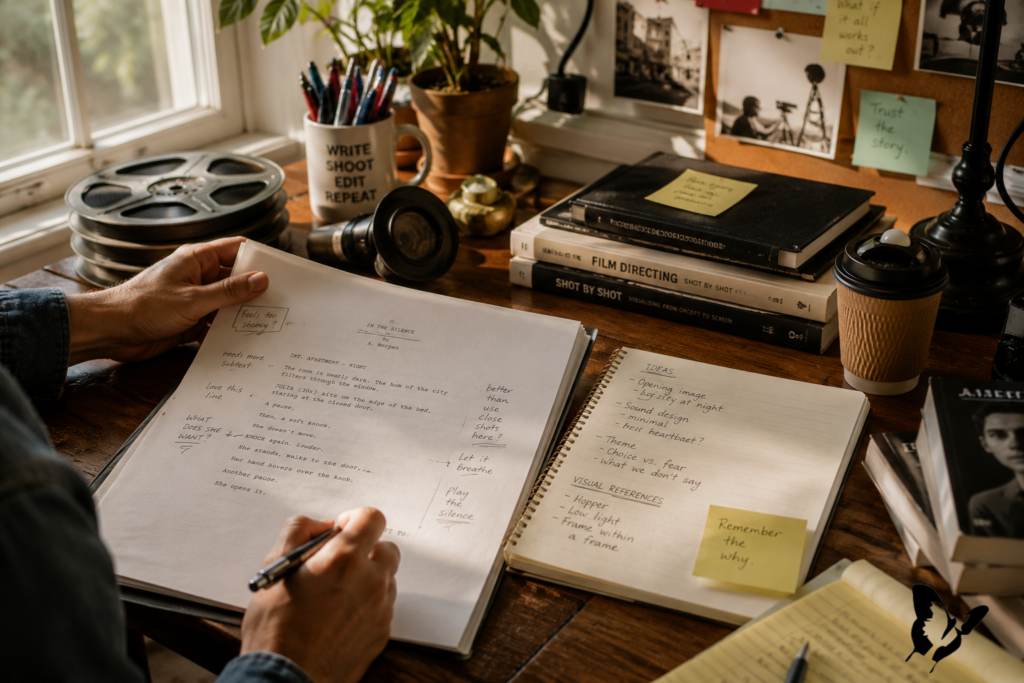
Before something new can exist, someone often has to imagine the possibility of it.
Long before human beings traveled to the moon, someone had to believe that reaching it might be possible.
Many of the technologies woven into ordinary life today—including the astonishing development of artificial intelligence—once belonged to the territory of imagination.
Medical discoveries begin with questions about what might be possible beyond what we can do today. Somewhere, researchers are imagining treatments and cures for diseases that generations before us could only hope to survive.
Imagination doesn’t stand opposite reality.
Sometimes it is how we begin changing reality.
Of course, not every imagined possibility becomes possible. And imagination alone doesn’t build rockets, develop medicines, create technology, write novels, design buildings, or solve difficult problems. Knowledge matters. Skill matters. Discipline, research, resources, collaboration, and years of work matter.
But before all of that, there is often a question:
What if?
Children ask it naturally.
Adults learn to ask another question first:
But is it realistic?
We need that question too.
I just wonder whether we sometimes ask it too soon.
Perhaps growing older doesn’t require us to leave imagination behind.
Perhaps it asks us to carry imagination differently.
We can understand responsibility and still wonder.
We can know that some things are difficult and still imagine how they might become better.
We can recognize limitations without allowing every limitation to become permanent in our minds.
And we can be practical without requiring every thought to prove its usefulness before we’re willing to entertain it.
Sometimes imagination may lead to something tangible—a story, a business, an invention, a journey, a solution to a problem.
Sometimes it may simply allow us to see our own lives differently.
To picture a place we’ve never visited.
To consider a path we’ve never taken.
To wonder whether something we’ve accepted as permanent might actually be capable of changing.
Or to sit quietly for a while with an idea that has no obligation to become anything at all.
There is value in that too.
I sometimes think about the little girl who could spend hours creating people and worlds from whatever happened to be around her. She didn’t ask whether those stories were productive. She didn’t wonder whether imagination would someday become useful.
She simply knew how to enter a possibility and stay there for a while.
I don’t think I outgrew her.
For a time, I simply stopped giving her as much room.
And maybe that’s true for more of us than we realize.
Maybe the imagination we once had isn’t gone.
Maybe it has been crowded by responsibility, discouraged by practicality, quieted by disappointment, or left unused for so long that we’ve mistaken silence for absence.
But quiet things can still be there.
I learned that when I picked up a pencil again.
Perhaps you won’t pick up a pencil.
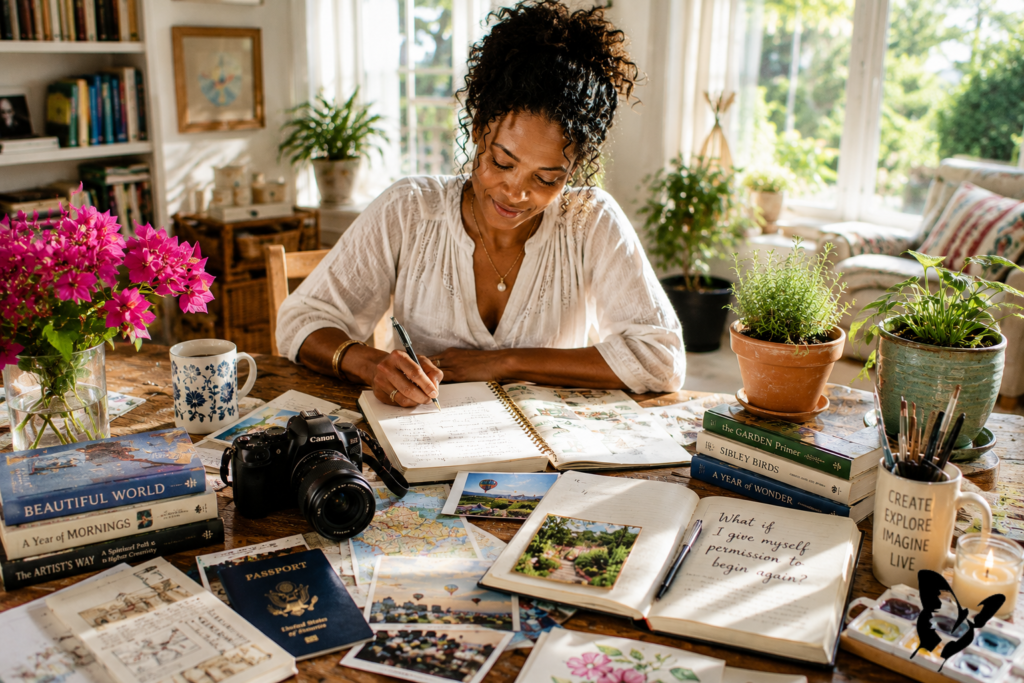
Perhaps your doorway will be a blank page, a garden, a passport, a camera, a recipe, a business idea, a conversation, a question you’ve been afraid to ask—or something neither of us could name yet.
That’s the wonderful thing about imagination.
We don’t have to know where it will take us before we’re allowed to use it.
So perhaps the question isn’t whether we’ve become too old to imagine.
Perhaps it’s whether we’ve become too accustomed to asking permission.
And if we have, maybe today we can give a little of that permission back to ourselves.
Ask the impractical question.
Follow the thought a little farther.
Let yourself wonder.
What if?
You don’t have to do anything with the answer.
Not yet.
For now, perhaps it’s enough simply to discover that some part of you is still willing to imagine one.