What We Leave at the Table
Life at the Hearth
by Sonia Vale
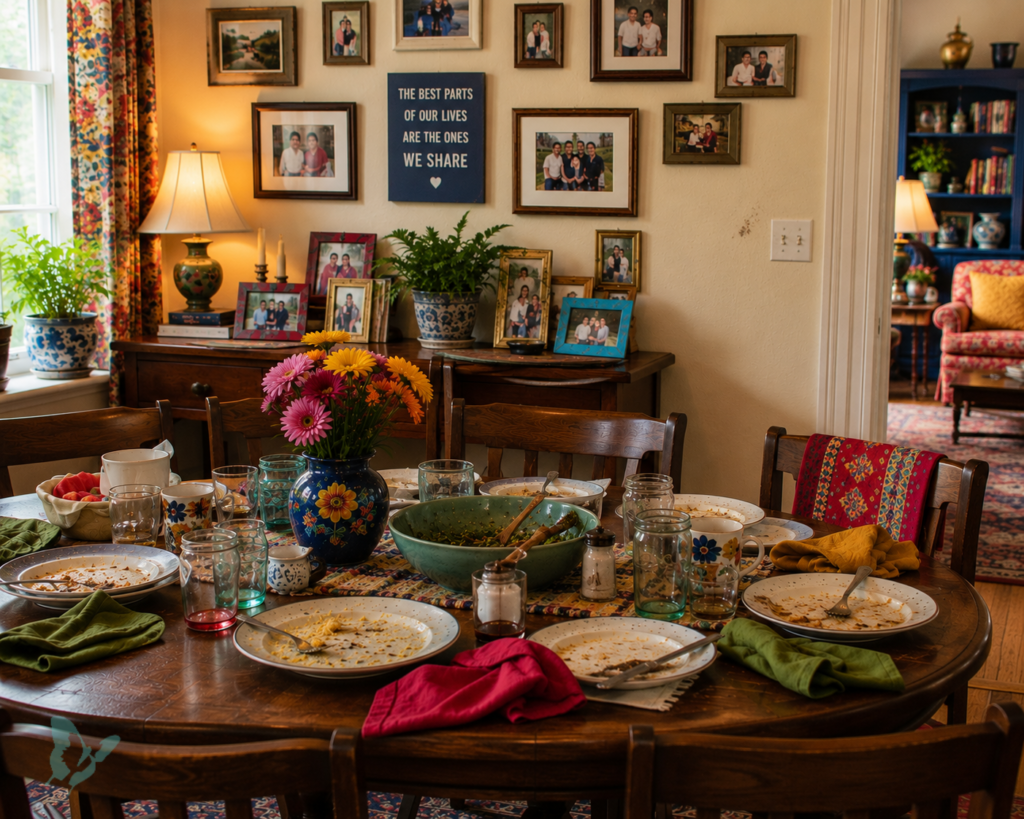
There is a particular moment after a family meal when dinner is technically over, but no one seems especially interested in leaving the table.
The plates are still there. Everyone is full and satisfied. Someone who couldn’t possibly need another bite is picking at whatever remains on their plate. Someone else reaches toward a favorite dish and serves themselves just a little more—not because they’re hungry, necessarily, but because it’s sitting there.
There is laughter.
Teasing.
The kinds of jokes that only work because everyone at the table already knows the stories behind them.
Eventually, someone starts going down memory lane.
Often, it is one of the older people at the table.
A name is mentioned. Then another. A story begins about a family member or friend who is no longer with us, and for a little while, the people who once sat at our tables seem to pull up chairs again.
Someone remembers something differently.
Someone corrects a detail.
Someone says, “That’s not how that happened.”
More laughter.
Before long, the stories turn toward the people who are still sitting right there.
And then someone reaches for a phone.
One photograph becomes five. The phone gets passed around. Someone else remembers a picture they have and pulls out their phone too.
Soon there are little groups around the table, each looking at something different.
And then somebody brings out an old photo album.
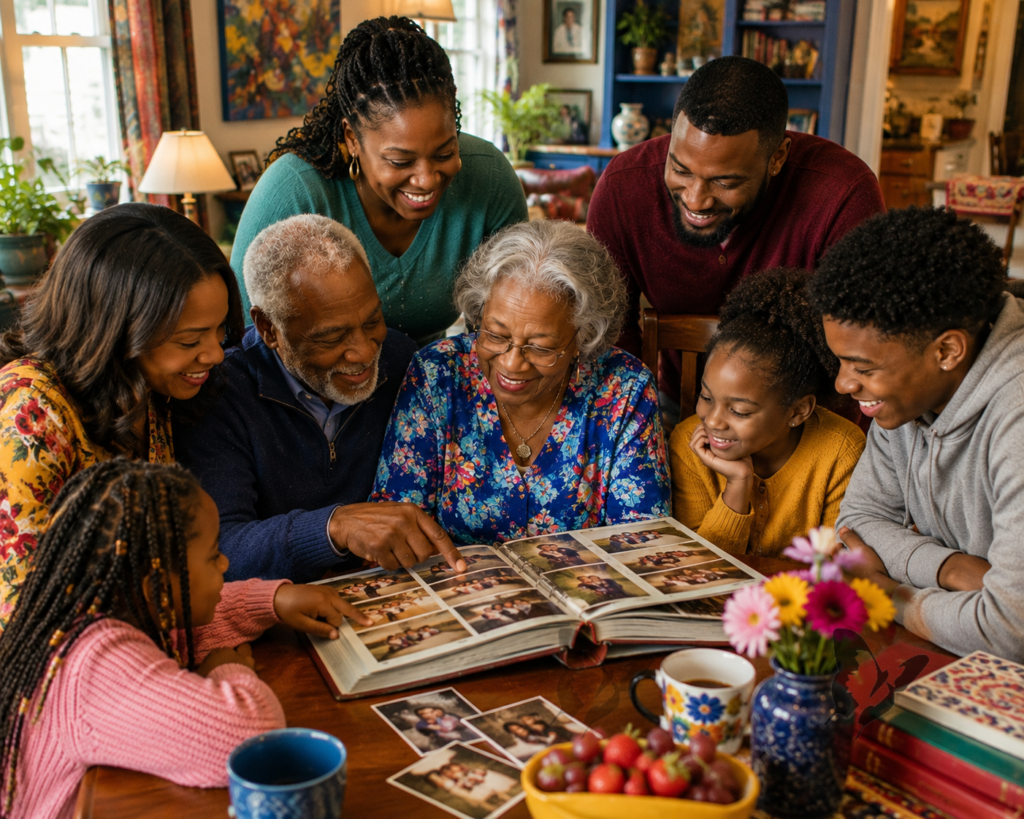
There is something about an old photo album that gets people every time.
Maybe it is because so many of the people we can no longer take pictures with are still there.
Maybe it is seeing people we have known all our lives at ages we never knew them.
Parents before they were parents.
Grandparents before they were grandparents.
Aunts and uncles when they were young enough to be wearing the questionable hairstyles and clothes that younger members of the family now find absolutely astonishing.
There is always at least one photograph that gets a reaction.
A child looks at the picture, then at the person sitting across the table, then back at the picture.
A hand flies over a mouth to contain the laughter.
“Wow!”
“You look so different!”
Or, occasionally and with varying degrees of accuracy:
“You haven’t changed a bit.”
The person in the photograph is usually a little embarrassed. Everyone else is delighted.
For younger children especially, an old album can seem like an artifact from another world. They are accustomed to photographs appearing instantly on a screen. Thousands of them can live inside a phone.
But these photographs can be held.
The pages turn.
The colors have changed with age. The clothes belong unmistakably to another time. So do the rooms, the furniture, the cars and the places in the background.
And somehow, sitting around the table looking at them together feels different from scrolling through photographs alone.
I have looked at ordinary family photographs years after they were taken and realized what they had kept for me.
Memories and moments that can never be recaptured.
Loved ones who are gone but will forever remain in my heart.
And versions of myself I can no longer return to.
The little girl.
The grade-school years.
Prom.
Different ages, different places, different versions of a life that helped shape the woman I eventually became.
A photograph cannot give us a moment back.
But it can keep something from it.
Perhaps that is why, sooner or later, we start taking new ones.
Usually photographs have already been taken throughout the gathering. But there is a little window after the meal and before everyone becomes very interested in finding the most comfortable, cushiony chair in the house.
That’s when you had better move quickly.
Because once a full person settles deeply enough into a good chair, negotiations may be required.
Eventually the table is cleared. People begin drifting into other rooms. Someone starts thinking about leaving.
And if we discover that a person who has been there all along somehow managed to avoid appearing in the photographs?
No.
Everybody back together.
One more picture.
People squeeze beside one another. Someone has to move over. Someone can’t be seen. Someone isn’t looking at the camera. Someone else is talking. Another person blinks.
And eventually, somehow, we get the crowded family photograph.
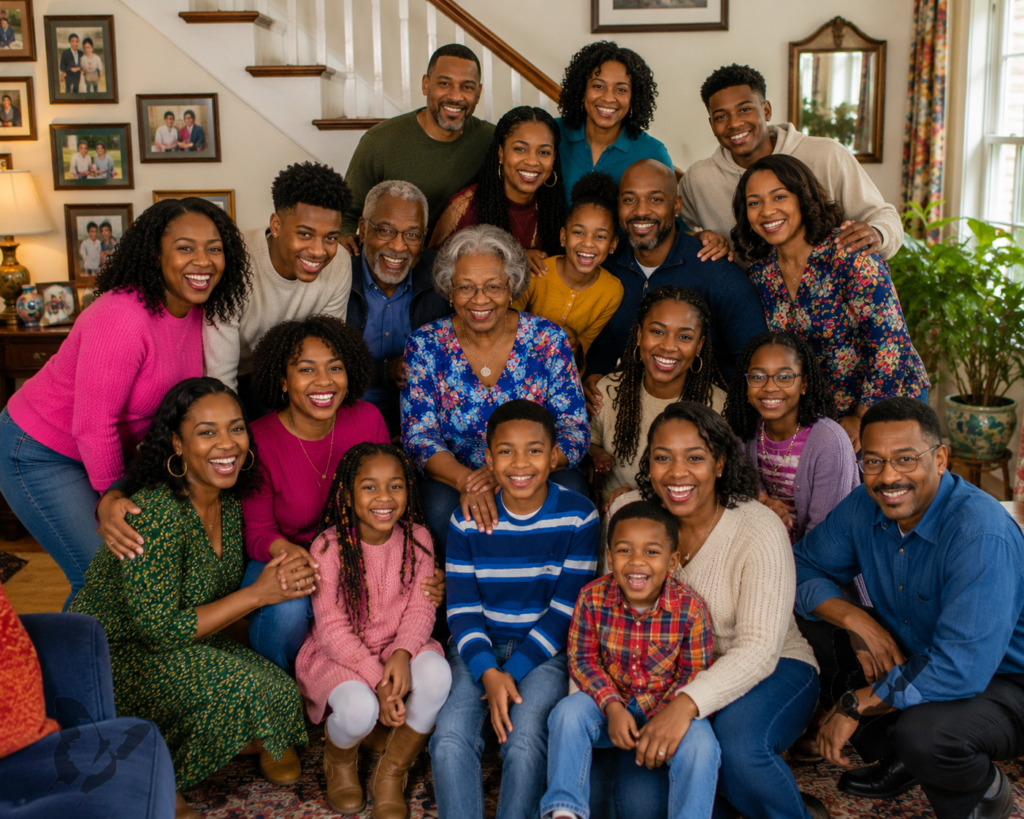
We don’t usually think about what we are doing in that moment.
We are simply taking a picture because everyone is together.
But someday, the new photographs become the old photographs.
I think about that more now.
I think about the children laughing over photographs today and how someday another child may stare at a picture of them and be equally horrified by whatever we once considered fashionable.
I think about who will tell the stories.
Who will remember the details differently.
Who will say, “That’s not how that happened.”
And I think about the traditions that will still be sitting around those tables.
I wasn’t handed the family traditions I wanted to pass down.
At least, not in the way we usually imagine traditions being inherited.
Some things I learned by watching. Some I saw in other families, through friends or even on television. And some of what I learned from my own upbringing came through understanding what I did not want.
Quite early, I began deciding what I wanted family to feel like.
I wanted warmth.
Togetherness.
Laughter.
Safety.
Tradition.
I wanted family and friends to feel something from the moment they walked through my door until the moment they left.
So I began building it.
I made the table warm.
I gathered people.
I cooked.
We ate.
We stayed.
We celebrated holidays and shared Sunday meals. We told stories. We took photographs and passed them around.
And we did it again.
And again.
And again.
I didn’t understand every time we gathered that repetition was doing some of the work.
One meal does not create closeness.
One holiday does not make a family tradition.
But all those ordinary occasions accumulate.
A family learns that there will be a place to come back to. They learn how it feels to linger after the meal. They learn the stories because they have heard them more than once. They learn that photographs are worth taking even when nothing extraordinary is happening.
Eventually, what someone once had to choose deliberately simply becomes part of how a family lives.
Today, I see my children and younger family members carrying pieces of those traditions forward.
That makes me proud.
It makes me happy.
Because I was able to give my children something I wasn’t given in the same way.
I became the beautiful change I wanted to see.
But I don’t want the generations after me simply to preserve what I created.
I hope they add to it.
I hope they make traditions of their own.
I hope their tables contain foods I never served and stories I never heard. I hope their children create rituals that would never have occurred to me.
Because perhaps what we pass down isn’t a set of instructions for recreating our lives.
Perhaps we give the people who come after us a foundation sturdy enough for them to build upon.
And maybe, many years from now, somewhere after another family meal, people will still be sitting around a table long after everyone has eaten enough.
There will be memories.
Laughter.
Echoes of shared stories.
There will be old photographs beside new ones.
And somewhere, I hope, there will be the evidence that people have really lived there.
In my house, there is a stubborn hint of a chocolate truffle stain on the wall in the corner.
It came from the very first dessert I made in this house.
I could tell you that it was simply too stubborn to come completely clean.
That would even be partly true.
But the other truth is that I secretly wanted a little of it to remain.
Not everything worth keeping belongs in an album.
Sometimes a life leaves its evidence on the wall.
And someday, when the people I love are sitting around tables of their own, I hope they won’t spend too much time trying to recreate mine.
I hope they build theirs.
I hope they fill them with people.
I hope they stay after the plates should have been cleared.
I hope they tell the old stories and make new ones.
I hope they take the photograph before everyone goes home.
And if, somewhere along the way, they leave a stain or two of their own— I hope they know better than to scrub too hard.